SINGAPORE, 30 October 2026 – Today, Delta Electronics, a global leader in power management and smart green solutions, hosted the annual Delta SEAO Future Industry Summit 2026 for the first time in Singapore, after seven consecutive editions in Thailand. Held under the theme “Advancing Regional Infrastructure for AI and Energy Transformation Evolution”, the Summit brought together over 200 prominent government officials, industry executives, academics, and media stakeholders to discuss solutions that accelerate the adoption of sustainable digital and energy infrastructure. This is aimed at supporting AI-driven growth across the Southeast Asia and Oceania (SEAO) region. At the Summit, Delta also deepened its collaboration with National University of Singapore (NUS) College of Design and Engineering (CDE) by joining the Sustainable Tropical Data Center Testbed (STDCT) Phase 2.0 Consortium to foster sustainable AI data center innovation.
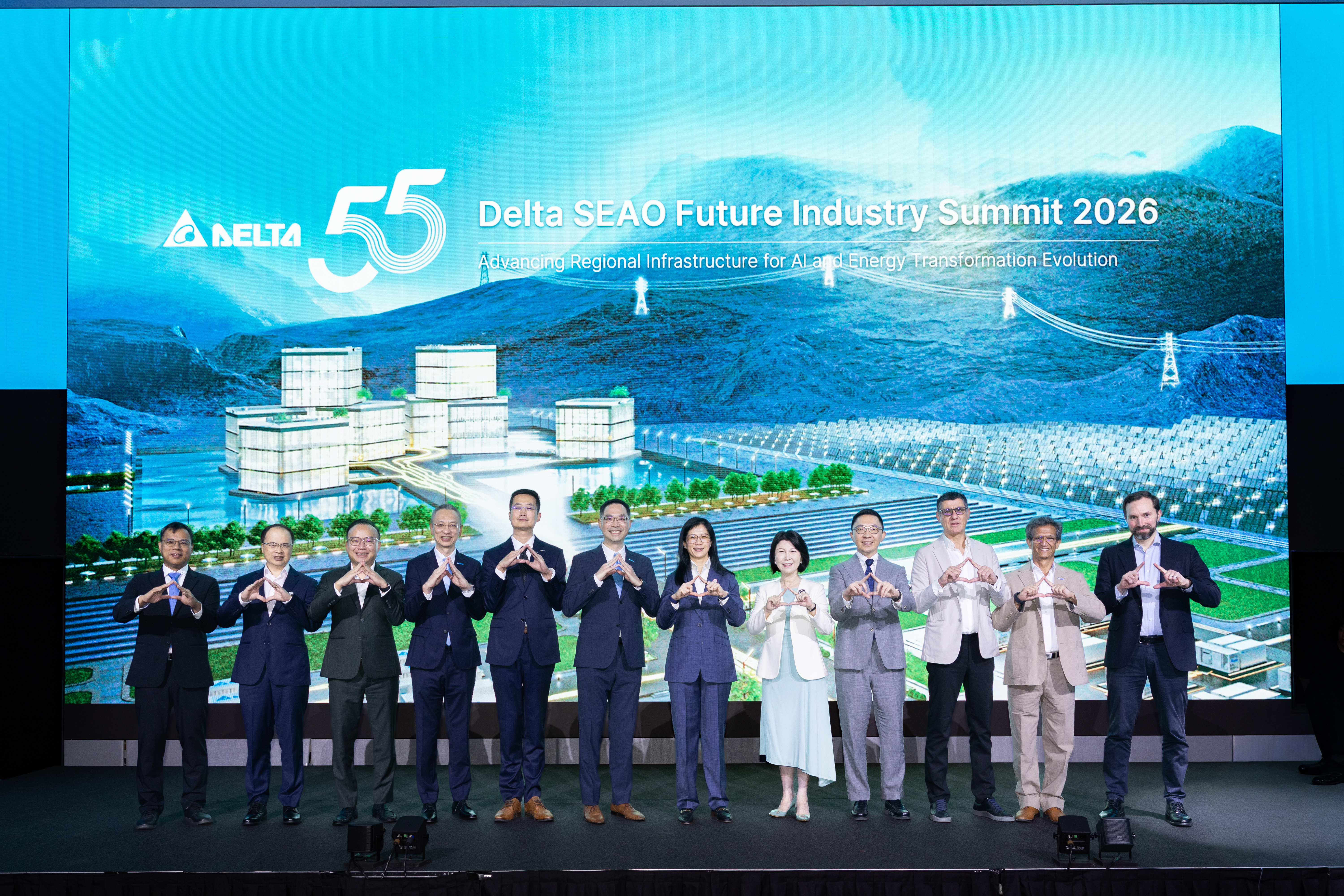
Shan-Shan Guo, Delta’s Chief Brand Officer, said, “The energy transition is essential to addressing climate change. The rise of electrification and AI infrastructure is making the need for resilient, energy-efficient power infrastructure increasingly urgent. Since its founding 55 years ago, Delta has been committed to driving sustainability through innovation and energy conservation. We are honored to share at the Delta SEAO Future Industry Summit some of Delta’s key sustainability endeavors, including the acceleration of the energy transition with our microgrid solutions, helping customers move toward net zero carbon emissions with our ESG consulting services, and our coral restoration journey in Singapore and other regions. Together with our customers and partners, we are building a smarter, greener tomorrow.
“Southeast Asia’s infrastructure needs are evolving rapidly as AI and electrification reshape the region. With its long-term development in power and thermal management, Delta brings deep expertise across power, cooling, automation and energy management,” said Jason Yuan, President of Delta Electronics Southeast Asia & Oceania. “Our strength lies in bringing these capabilities together to help build future-ready infrastructure that is reliable, scalable, efficient and adaptable to the region’s needs. That is the conversation we want to advance by bringing our annual SEAO Summit to Singapore.”
The program included executive keynotes and two panel discussions focused on energy infrastructure readiness for the region’s data centers and the role of industrial and building automation in sustainable manufacturing. The Singapore edition builds on Delta’s growing engagement across Southeast Asia, following the opening of its new Johor Bahru office and the Solutions Day forum in Kuala Lumpur in July. Together, these initiatives reflect Delta’s continued investment in the region and its focus on supporting the infrastructure demands created by AI, electrification and industrial transformation.
The Summit arrives as Southeast Asia’s data center power demand grows faster than any other region in the world. According to an IDC study commissioned by Delta (*), surveyed Southeast Asian operators reported 26-50% year-on-year growth in power demand, against 11-20% in the United States and Europe. 60% here are also already deploying, planning, or evaluating direct liquid cooling, the highest adoption rate of the three regions surveyed. The same study found that 24-26% of Southeast Asian operators cite cluster around power, grid, cooling capacity and equipment lead-time risks as their single biggest constraint on scaling.
Singapore is also investing in the infrastructure and research capabilities needed to support the next generation of data centers. The country is developing new approaches to tropical data center design and testing, including through the STDCT, hosted at the NUS CDE.
Collaboration with NUS to Advance Sustainable Data Center Innovation
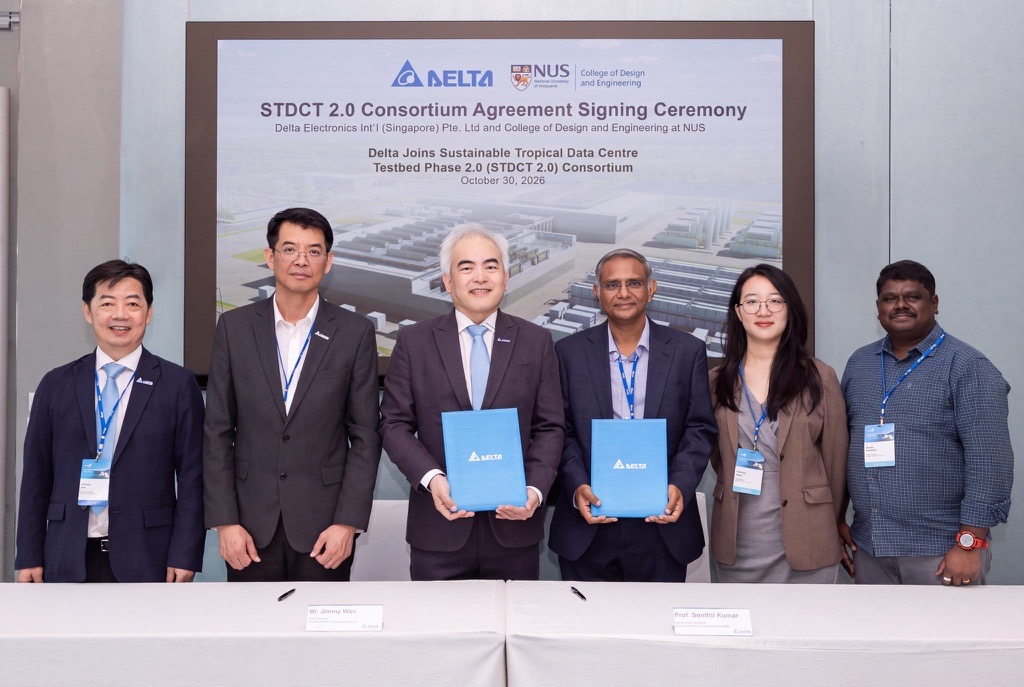
Against this backdrop, Delta formalized today, at the Delta SEAO Future Industry Summit 2026, its deepening collaboration with NUS CDE through its participation in the Sustainable Tropical Data Centre Testbed Phase 2.0 (STDCT 2.0) Consortium. As part of the collaboration, Delta will provide NUS CDE with an AI Containerized Data Center and related equipment, to support research and testing of data center technologies suited to tropical conditions. The collaboration brings together Delta’s expertise in power, cooling, and data center infrastructure with NUS CDE’s research capabilities in tropical data center design and testing.
“AI is fundamentally changing the design envelope for data centers, with much higher power densities and thermal loads placing new demands on power, cooling and infrastructure efficiency,” said Professor Lee Poh Seng, Programme Director of STDCT 2.0 and Head of the Department of Mechanical Engineering at NUS CDE. “STDCT 2.0 is designed to bridge the gap between innovation and real-world deployment by providing a live environment in which next-generation technologies can be integrated, tested and validated under tropical operating conditions. Delta brings deep capabilities across power electronics, thermal management and data center infrastructure, and this collaboration will enable us to explore these technologies at system level and demonstrate measurable improvements in energy efficiency, water efficiency, reliability and climate resilience. Our goal is to generate solutions and evidence that can accelerate the deployment of more sustainable AI infrastructure in Singapore and across the wider region.”
As AI and electrification reshape infrastructure needs across Southeast Asia, the Delta SEAO Future Industry Summit 2026, held at Pan Pacific Orchard, brings these stakeholders together to fulfil the region’s infrastructure needs.
*IDC InfoBrief, sponsored by Delta, Powering AI Growth: From Grid Constraints to Rack Readiness, #AP242570-IB, September 2026